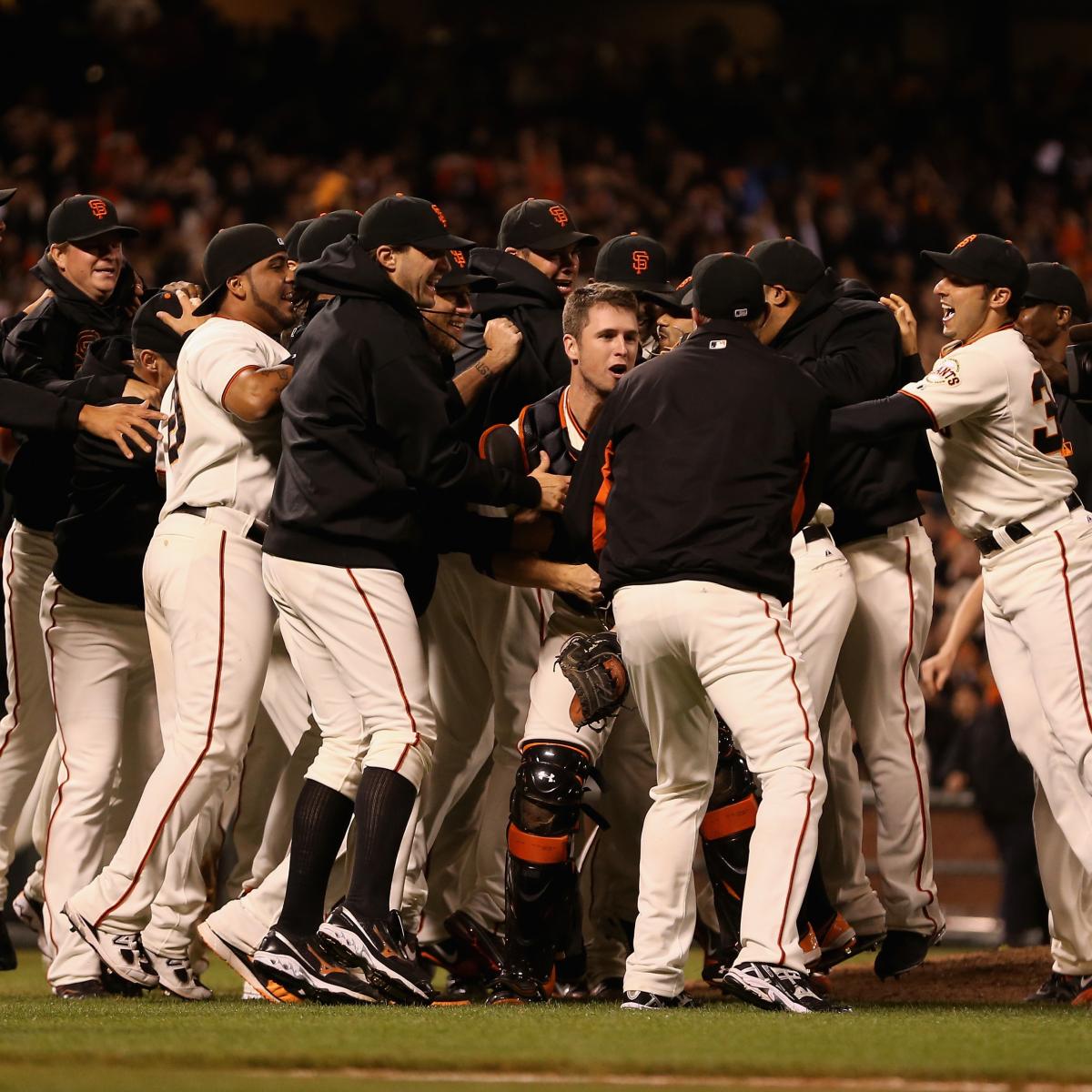
If you look at the San Francisco Giants roster 2012 on paper today, it looks like a collection of misfits that had no business winning a World Series, let alone sweeping a Tigers team featuring Justin Verlander and Miguel Cabrera in his Triple Crown year. It was a weird year. Seriously.
The season didn't start with a parade in mind. It started with a massive hole at second base and a pitching staff that was leaning heavily on a guy named Ryan Vogelsong, who spent years pitching in Japan because nobody in MLB wanted him. But that’s the magic of that specific 2012 group. They weren't the most talented team in the league. Honestly, the Dodgers and the Nationals probably had "better" rosters. But the Giants had this strange, kinetic energy where every single player on the 25-man roster had a moment of inexplicable brilliance right when the season was about to fall off the rails.
The Pitching Staff That Refused to Break
Everything started with Matt Cain. 2012 was his masterpiece. He threw the first perfect game in franchise history against the Astros in June, and he was the rock. But look past Cain. You had Tim Lincecum, who was effectively losing his "Freak" status in real-time. His ERA was ballooning. He was losing velocity. Most managers would have buried him, but Bruce Bochy moved him to the bullpen for the postseason, and he became a weapon of mass destruction.
Then there was Barry Zito. People love to joke about that contract, but without Zito, there is no 2012 trophy. His performance in Game 5 of the NLCS against the Cardinals—facing elimination in St. Louis—is the stuff of legend. He out-dueled Lance Lynn and kept the season alive with a bunting clinic and a curveball that finally looked like the $126 million version.
The bullpen was a different beast altogether. Brian Wilson, the bearded face of the "Fear the Beard" era, went down with Tommy John surgery almost immediately. Enter Sergio Romo. He didn't look like a closer. He didn't throw 100 mph. He just threw sliders that defied physics. Watching him freeze Miguel Cabrera for the final out of the World Series with a fastball right down the middle was the most "2012 Giants" thing ever. It was a bluff. It worked.
The Infield: Scutaro and the Blockbuster Trade That Actually Worked
We have to talk about Marco Scutaro. When Brian Sabean traded for him in July, nobody threw a party. He was a veteran journeyman. He was "fine." Then he got to San Francisco and turned into a hitting god. He hit .362 after the trade. In the pouring rain of the NLCS, he stood there with his eyes toward the sky, soaking it in while catching the final out. He was the heartbeat of the San Francisco Giants roster 2012.
Around him, the infield was solid but quirky. Brandon Belt was still "Baby Giraffe," trying to find his swing and dealing with Bochy’s "tough love" benchings. Brandon Crawford was a local kid who looked like he could win a Gold Glove but couldn't hit a beach ball yet—though he eventually found his stroke. And Pablo Sandoval. The Kung Fu Panda. He missed a chunk of time with a hamate bone injury, came back, and then hit three home runs in a single World Series game off Justin Verlander.
Verlander looked confused. The world was confused. But that was Pablo.
Buster Posey’s Return to Greatness
You can't discuss this roster without mentioning the comeback. In 2011, Posey’s leg was essentially destroyed at home plate by Scott Cousins. People wondered if he’d ever be the same.
He wasn't the same. He was better.
Posey won the NL MVP in 2012. He hit .336. He caught almost every meaningful inning. He was the stabilizing force for a pitching staff that was often volatile. When you look at the San Francisco Giants roster 2012, Posey is the undisputed anchor. He provided the "professionalism" that allowed guys like Hunter Pence to be absolute maniacs.
Speaking of Pence, he was the final piece. Acquired from the Phillies at the deadline, he brought the "Reverend" energy. His swing was ugly. His throwing motion looked like he was trying to shot-put a bowling ball. But his speeches in the dugout during the elimination games against Cincinnati and St. Louis are what fans remember most. He told them they didn't want the season to end. He was right.
The Forgotten Names of the 2012 Run
Everyone remembers Buster and Pablo, but this team won because of guys like Gregor Blanco. Blanco was a minor league invitee who ended up making a diving catch to save Matt Cain's perfect game. He was a defensive wizard who filled the void left by Melky Cabrera.
Ah, Melky. We have to be honest about that situation. Melky Cabrera was leading the league in hitting and was the All-Star Game MVP before he got slapped with a 50-game suspension for PEDs. It could have tanked the team. Instead, the roster rallied. They basically said, "Okay, we don't need him," and they didn't. They replaced a batting champion with a committee of Blanco, Angel Pagan, and a rotating cast of characters.
Angel Pagan brought the "salute." He brought speed. He brought a level of intensity that the Giants lacked in the outfield. He was the perfect leadoff hitter for that specific chemistry.
How They Survived Six Elimination Games
No team had ever done what the 2012 Giants did. They were down 2-0 to the Reds in the NLDS. They had to go to Cincinnati and win three straight. They did it. They were down 3-1 to the Cardinals in the NLCS. They won three straight.
This wasn't luck. It was a roster built for depth. When a starter struggled, the middle relief—guys like Jeremy Affeldt, Santiago Casilla, and Javier Lopez—shut the door. Affeldt, in particular, remains one of the most underrated postseason pitchers in history. He just didn't give up runs.
The San Francisco Giants roster 2012 was a masterclass in "The Whole is Greater than the Sum of its Parts." If you look at the individual WAR (Wins Above Replacement) of these guys, it’s not a legendary list. But as a unit, they were unbreakable.
Key Statistics and Roster Breakdown
If you're looking for the hard data on how this team functioned, it’s in the pitching. The team ERA was 3.68, which was 5th in the NL. They didn't lead the league in home runs (they actually hit the fewest in the MLB with only 103), but they led in "grinding."
- Catchers: Buster Posey, Hector Sanchez.
- Infielders: Brandon Belt, Brandon Crawford, Marco Scutaro, Pablo Sandoval, Joaquin Arias, Ryan Theriot.
- Outfielders: Angel Pagan, Hunter Pence, Gregor Blanco, Xavier Nady.
- Starting Rotation: Matt Cain, Madison Bumgarner, Tim Lincecum, Ryan Vogelsong, Barry Zito.
- Key Relievers: Sergio Romo, Jeremy Affeldt, Javier Lopez, Santiago Casilla, Clay Hensley.
Look at Ryan Theriot. "The Riot." He scored the winning run in the World Series on a Scutaro single. He was a "scrap" player. That was the 2012 vibe.
The Misconception of "Fluke"
A lot of analysts at the time called this run a fluke. They pointed to the Melky suspension and the aging veterans. But the Giants proved that a roster built on high-contact hitters and a versatile bullpen is a nightmare in October. They didn't strike out. They put the ball in play. They forced the other team to make mistakes. In a seven-game series, that's how you win.
Actionable Insights for Giants Fans and Historians
If you want to truly appreciate the 2012 season, don't just watch the World Series highlights. Go back and watch the NLDS Game 5 against the Reds. Watch the grand slam by Buster Posey that silenced the Great American Ball Park. That is where the soul of this roster was revealed.
How to Study This Roster Today:
- Watch the "Together" Documentary: It captures the clubhouse speeches and the Pence "Reverend" moments that stats can't show.
- Analyze the Bullpen Usage: Notice how Bochy used Javier Lopez specifically for left-handed hitters. It was a proto-version of modern analytics before "openers" were a thing.
- Check the Splitting Stats: Look at Marco Scutaro's numbers with runners in scoring position. It’s almost impossible to replicate.
- Value the Defense: Re-watch Gregor Blanco’s positioning. He was often exactly where the ball was hit before it was even swung at.
The San Francisco Giants roster 2012 wasn't just a group of baseball players; they were a group of survivors. They survived injuries, suspensions, and six games where a single loss would have sent them home. They taught us that being "the best" isn't nearly as important as being "the right team at the right time."
To understand the 2012 Giants is to understand that baseball is about more than just exit velocity. It's about Barry Zito bunting for a hit. It's about Sergio Romo's "no-dot" slider. It's about a group of guys who refused to believe they were out of it.
If you are looking for a blueprint on how to build a championship team without a $300 million payroll or a lineup of 40-home-run hitters, the 2012 Giants are the primary case study. They proved that depth, contact hitting, and a lights-out bullpen are the true currency of October.
Next Steps for Research:
Examine the 2012 MLB Draft and free agency moves made by Brian Sabean to see how he specifically targeted veteran contact hitters to balance out the young, power-pitching core. Compare the 2012 roster structure to the 2010 and 2014 championship teams to see the evolution of "Torture" baseball in the Bay Area.