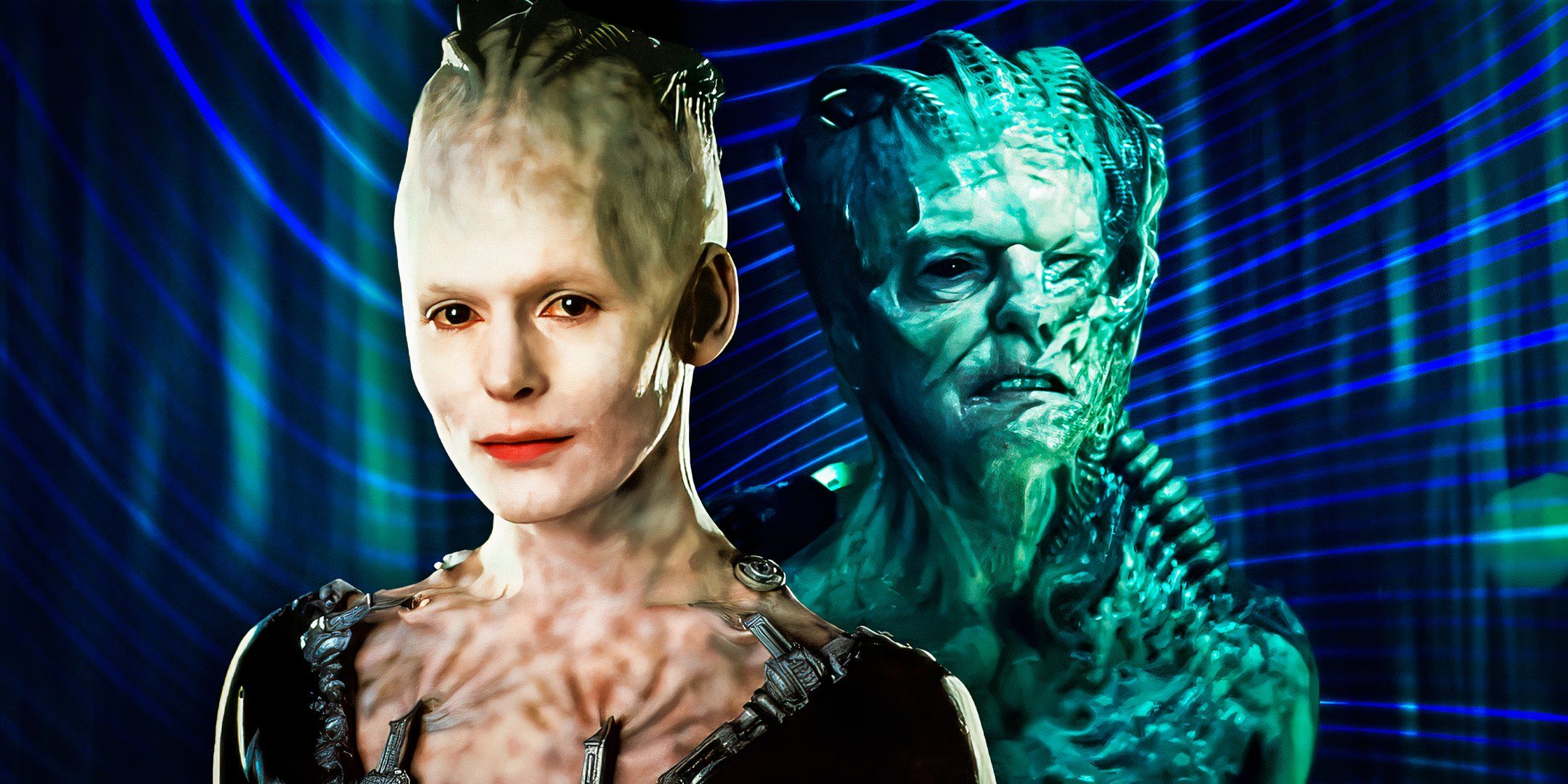
The first time we saw her, it felt like a betrayal of everything we knew about the Collective. For years, the Borg were this faceless, unstoppable wall of white skin and black tubes. They didn't have a "leader." They were a hive. Then, in 1996, Star Trek: First Contact dropped Alice Krige onto a mechanical hook, lowering her into a suit of armor, and suddenly the "I" replaced the "We." The Star Trek Borg Queen changed the franchise forever, and honestly, the fanbase is still arguing about whether that was a good move or a total disaster for the horror of the Borg.
She isn't just a villain. She’s a contradiction.
Think about it for a second. The Borg represent the death of the individual, yet here is this highly sexualized, manipulative, and deeply individualistic entity running the show. She claims to "bring order to chaos," but she’s the most chaotic element in their entire history. She’s seductive. She’s cruel. She’s lonely.
The Origin of the Star Trek Borg Queen: Why She Exists
Fans often ask why the writers felt the need to give the Borg a face. If you look at "The Best of Both Worlds," the Borg were scary because they couldn't be reasoned with. You can't talk to a hurricane. But for a feature film like First Contact, the producers realized they needed a central antagonist. You can't have a dramatic climax where Patrick Stewart shouts at a generic wall of cubes. You need a person.
Alice Krige brought a "space-vampire" energy that made the Star Trek Borg Queen work. She didn't just want to assimilate Earth; she wanted to seduce Data and break Picard. It turned a galactic threat into a personal grudge match.
But where did she come from?
The lore is messy. Brannon Braga and Ronald D. Moore have talked about how she was conceived as the "one who is many." She isn't a queen in the sense of a biological monarch like a bee. She’s more like a focal point. A processor. When one body dies, her consciousness—the "essential her"—just downloads into a new one. This explains why we see her die in First Contact, only to pop up again in Voyager played by Susanna Thompson.
The Different Faces of the Hive
- Alice Krige: The original. Moist, metallic, and terrifyingly intimate.
- Susanna Thompson: The "Bureaucrat" Queen. She was more of a cold tactician who spent her time tormenting Seven of Nine.
- Annie Wersching: The Picard Season 2 version. This was a broken, desperate Queen who felt more human and, in some ways, more dangerous because she had nothing left to lose.
- Jane Edith Wilson: Briefly voiced her in Bridge Commander, proving the character works even when you can only hear her.
Is She a Continuity Error or a Necessity?
Hardcore Trekkies love to point out that the Star Trek Borg Queen kinda ruins the original concept of the Borg. In The Next Generation, the Borg were a decentralized network. If you blew up one ship, the rest didn't care. By introducing a Queen, the writers created a "load-bearing boss."
If you kill the Queen, the Borg fall apart. We saw it in First Contact when the drones deactivated after her "organic" components melted. We saw it again in the Voyager finale, "Endgame," where a neurolytic pathogen sent from the future basically gave her a digital stroke and blew up the Unicomplex.
It makes them easier to beat. That's the reality.
However, looking at it through a modern lens, the Queen represents the inevitable ego of any system. Even a perfect collective eventually develops a hierarchy. You can't coordinate billions of minds across multiple quadrants without some kind of "primary CPU." She is the manifestation of the Collective's will. She is the one who speaks because the drones literally cannot.
The Seven of Nine Connection
You can't talk about the Queen without talking about Annika Hansen. The Queen’s obsession with Seven of Nine in Voyager was almost parental. She didn't just want Seven back in the hive; she wanted Seven to choose to come back. It was a weird, twisted psychological game. It suggested that the Queen experiences something 99% of Borg don't: loneliness. She has all these voices in her head, but no one to actually talk to.
The "New" Queen: What Happened in Star Trek: Picard?
The most recent evolution of the Star Trek Borg Queen is perhaps the most fascinating. In Picard Season 2, we saw a version of the Queen from an alternate timeline who was the last of her kind. Seeing her stripped of her ships and her millions of drones was jarring. She was just a head and a torso hanging in a basement.
Then came the Jurati-Queen.
This was a massive shift. Instead of a Queen who consumes and assimilates by force, Agnes Jurati convinced the Queen that a "collective of the willing" was more efficient. It was a soft reboot of the entire species. This new Borg faction became a protective force, guarding a mysterious transwarp conduit.
But then, Picard Season 3 pulled the rug out. It showed us the "Original" Queen again—or what was left of her. Hidden inside a nebula, starving, and eating her own drones to survive. She was voiced by Alice Krige again (though played physically by Jane Edwina Seymour), and she was grotesque.
This version wasn't seductive. She was a corpse. A literal skeleton of an empire. It was a poetic end to the character—seeing the "perfection" she sought turn into a decaying, cannibalistic nightmare.
Why the Borg Queen Matters to Sci-Fi
The Star Trek Borg Queen is a cautionary tale about the centralization of power. She represents the "Totalitarian Ego." In a world where we are increasingly connected by algorithms and social networks, the idea of a single "voice" that directs the masses is actually more relevant now than it was in 1996.
She also broke the mold for female villains in science fiction. She wasn't just a "bad woman." She was an elemental force that used intimacy as a weapon. When she blows on Data's skin to see if he can feel, it's one of the most unsettling moments in cinema history because it's so voyeuristic and strange.
Common Misconceptions
- She's the "Leader": Not exactly. She is the Borg. When she says "I am the Borg," she isn't lying. She is the personification of the entire network.
- There’s only one: Technically, yes, but her "software" can inhabit many "hardwares."
- She was created for Voyager: Nope. First Contact (the movie) came first. Voyager just leaned into her because they needed a recurring foil for Captain Janeway.
How to Understand the Queen’s Timeline
If you're trying to track her appearances, don't look for a linear path. Look for themes.
In the 2060s (the events of First Contact), she's at her peak, trying to stop humanity before they even reach the stars. By the 2370s (Voyager), she’s an established galactic superpower, playing chess with Janeway and trying to assimilate Species 8472. By the early 25th century (Picard), she’s either a reformed guardian (the Jurati version) or a dying relic of a lost age.
It’s a tragic arc, honestly. She went from being the goddess of the most feared empire in the galaxy to a literal voice in the dark, begging for a way to survive.
Actionable Insights for Fans and Writers
If you’re a creator or a deep-lore enthusiast looking to utilize the concept of a "Hive Queen" like the Star Trek Borg Queen, here are a few things to keep in mind regarding her character's impact:
1. Focus on the "Linchpin" Vulnerability
Understand that introducing a leader to a faceless mob makes the mob more relatable but also more fragile. If you're writing your own sci-fi, decide if the "Queen" is a physical necessity or a psychological one. The Borg became less scary but more "humanly" villainous once she arrived.
2. Watch the Performance Nuances
If you really want to appreciate the character, watch First Contact and then the Voyager episode "Dark Frontier" back-to-back. Notice how Alice Krige uses her physicality—lots of neck tilts and finger movements—versus Susanna Thompson’s more rigid, commanding presence. It shows how the same "character" can be played with different flavors of menace.
3. Explore the "Consensual Collective" Idea
The Jurati-Queen arc is a great case study in how to "redeem" an irredeemable villain. It asks the question: Can you have the benefits of a hive mind (shared knowledge, no loneliness) without the horror of assimilation? It's a great philosophical rabbit hole for any Trek fan.
4. Don't Ignore the Audio
The sound design of the Queen—the mechanical clicking, the overlaid voices, the skin-crawling whispers—is half the battle. If you're revisiting these episodes, wear headphones. The way her voice is mixed is a masterclass in building tension.
The Queen isn't just a monster. She’s the mirror of our own desire for order, taken to its most terrifying, absolute extreme. She remains the most complex villain in the Star Trek pantheon because she doesn't just want to kill the heroes—she wants them to become her. And that's way worse.