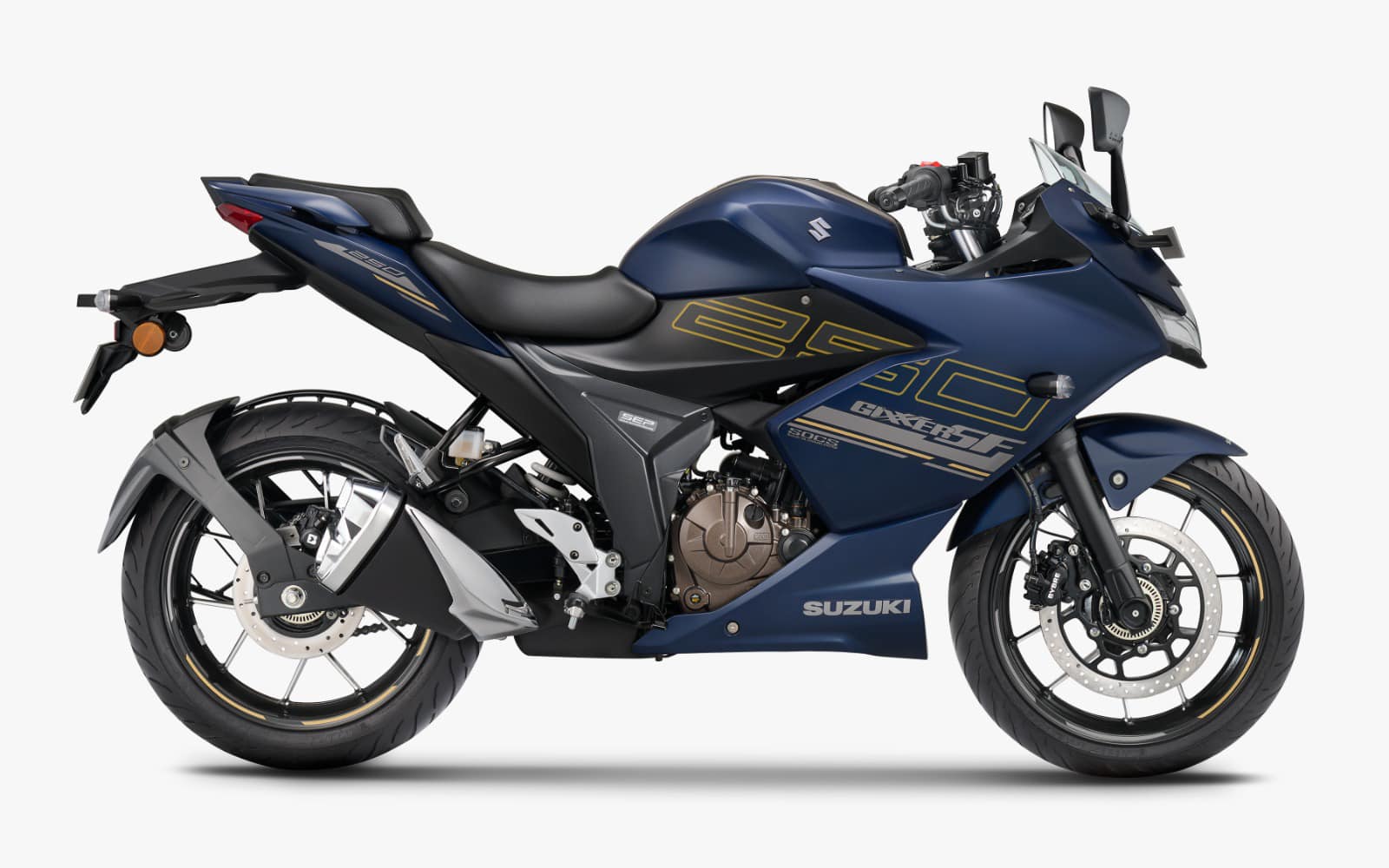
Let's be real for a second. Most of us don't live at the track. We spend our lives dodging potholes, filtering through gridlocked morning commutes, and occasionally finding a decent stretch of asphalt on a Sunday morning that isn't crawling with highway patrol. This is exactly where most 250cc bikes fail. They’re either too buzzy, too aggressive, or so cheap they feel like toys. Then there’s the Suzuki Gixxer 250 SF.
It’s a weirdly honest machine.
While everyone else is busy chasing 15,000 RPM redlines or adding complex electronics that just drive the price up, Suzuki did something radical. They looked at what actually makes a motorcycle fun to live with every single day. They built a bike that doesn't try to be a miniature MotoGP replica, even though the fairings might suggest otherwise. It’s a tool. A sharp, fuel-injected, oil-cooled tool that handles the "boring" stuff with as much enthusiasm as the twisties.
The SOCS Secret: Why the Suzuki Gixxer 250 SF Doesn't Need a Radiator
If you look closely at the engine, you'll notice something missing. There are no coolant hoses. There’s no bulky radiator taking up space behind the front wheel. Most people assume that high-performance 250s must be liquid-cooled to survive, but the Suzuki Gixxer 250 SF uses the Suzuki Oil Cooling System (SOCS).
This isn't just a marketing gimmick. It’s an engineering flex.
By using the engine oil to cool the hottest parts of the cylinder head, Suzuki managed to keep the engine incredibly slim and lightweight. It’s a system derived from their experience in endurance racing and the legendary GSX-R750 of the 80s. Because there's no water jacket or coolant pump, the bike feels narrower between your knees. It also means one less thing to maintain. No checking coolant levels, no worrying about cracked hoses, and significantly less weight.
Weight matters. A lot. Especially when you're trying to flick a bike through a tight S-bend or back it into a narrow parking spot at the grocery store.
The power delivery from this 249cc single-cylinder mill is... surprising. It’s not going to rip your arms off, obviously. You’re looking at around 26.5 PS and 22.2 Nm of torque. But it’s the way it delivers that power. Unlike the high-strung twins found in some competitors, the Gixxer has meat in the midrange. You don't have to dance on the gear lever like a caffeinated tap dancer just to overtake a truck on the highway. You twist the throttle, the fuel injection reacts instantly, and you just go.
Riding Position and the Ergonomic Lie
We’ve been lied to about what a "Sport" bike should feel like. The industry has convinced us that if your wrists aren't screaming and your back doesn't feel like a question mark after thirty minutes, you aren't "really" riding.
The Suzuki Gixxer 250 SF disagrees.
It has clip-on handlebars, but they aren't buried down by the front axle. They’re raised. It’s a "committed but comfortable" stance. You’re tucked enough to hide from the wind blast at 120 km/h, but upright enough that you can actually see over the roof of the SUV in front of you. Honestly, it’s one of the few bikes in this displacement class that doesn't feel cramped for riders over six feet tall.
The seat height is a manageable 800mm. That's the sweet spot. It’s low enough for most beginners to get their feet down, but the bike still has enough ground clearance that you aren't scraping pegs the moment you see a corner.
Real World Performance vs. Spec Sheet Warriors
I see it all the time on forums. "Why would I buy a single-cylinder Suzuki when I could get a twin-cylinder bike with 10 more horsepower?"
It’s a fair question until you actually ride them back-to-back.
Multi-cylinder small-displacement bikes often feel "hollow" at the bottom of the rev range. You have to scream them to 10,000 RPM just to pull away from a stoplight with any dignity. The Suzuki Gixxer 250 SF is the opposite. It’s punchy. It’s designed for the "stop-and-go" reality of modern cities.
Then there’s the fuel economy. Suzuki’s SEP (Suzuki Eco Performance) tech is actually impressive here. In real-world mixed riding, you can easily see 30-35 km/l. With a 12-liter tank, you’re looking at a range that makes it a legitimate light-touring contender. You can ride out of the city, hit the mountains, and get back home without constantly scanning the horizon for a gas station.
The suspension setup is basic, but well-sorted. You get telescopic forks up front and a swingarm-mounted monoshock at the back. It’s firm. If you’re riding over cobbles or massive expansion joints, you’re going to feel it. But that firmness translates to confidence when you lean the bike over. There’s no wallowing or "pogo-stick" feeling that plagues cheaper entry-level bikes.
Braking and Safety: The Dual-Channel Standard
Brakes are where manufacturers usually cut corners to save a few bucks. Suzuki didn't. The Suzuki Gixxer 250 SF comes standard with dual-channel ABS.
This is non-negotiable in 2026.
The ByBre calipers (a brand owned by Brembo) provide plenty of bite. The front disc is large enough to handle aggressive mountain descents without fading into mush. The ABS intervention isn't overly sensitive either; it doesn't kick in the second you breathe on the lever, which allows for some "spirited" riding before the computer takes over.
Maintenance: The Silent Advantage
Owning a bike is more than just the monthly payment. It’s the Saturday mornings spent in the garage.
Because the Gixxer 250 SF is so mechanically simple—one cylinder, no liquid cooling—maintenance is a breeze. Changing the oil takes ten minutes. The air filter is easily accessible. Suzuki parts are notoriously affordable and, more importantly, they are available.
There's a specific kind of peace of mind that comes with knowing your bike isn't a "diva." It doesn't need specialized diagnostic tools for every little thing. It just works. You press the starter, it fires up (thanks to that "Suzuki Easy Start System" which is basically just a one-touch button), and you're off.
The Aesthetic: Looks Like a 600, Moves Like a 250
Suzuki’s design language for the SF (Sport Fairing) is heavily inspired by the GSX-R1000. It’s sharp. The LED headlight assembly has this predatory, tiered look that actually throws a decent beam at night. The fairing isn't just for show; it’s surprisingly effective at keeping the wind off your chest.
However, let’s be honest about the finish. While the paint quality is generally excellent—especially that Metallic Matte Black or the classic Triton Blue—some of the plastics around the cockpit can feel a bit thin. It’s not a dealbreaker, but it reminds you that this is a bike built to a specific price point.
The digital instrument cluster is a bit of a throwback. It’s a simple LCD. No fancy TFT screen, no Bluetooth turn-by-turn navigation, no integrated Spotify controls. For some, this is a downside. For others, it’s a blessing. It’s high-contrast, easy to read in direct sunlight, and tells you exactly what you need to know: speed, gear position, and RPM. Sometimes, less is more.
What Most People Get Wrong About the Gixxer 250
The biggest misconception is that this is a "beginner bike" you’ll grow out of in six months.
That’s a narrow way to look at motorcycling.
Expert riders often gravitate toward bikes like the Suzuki Gixxer 250 SF because they understand the "slow bike fast" philosophy. You can use 100% of this bike's potential on a public road without ending up in jail. You can bang through the gears, tuck behind the screen, and feel like a hero, all while doing the speed limit.
It’s also an incredible "second bike." If you have a 250kg adventure tourer or a 200-horsepower superbike, you know they are a massive pain to take to the gym or the office. The Gixxer is the antidote to that. It’s light, it’s narrow, and it’s genuinely fun to toss around in traffic.
Actionable Advice for Potential Owners
If you're looking at picking up a Gixxer 250 SF, here are three things you should actually do:
- Check the tires immediately. While the stock radials are decent, they are designed for longevity, not ultimate grip. If you plan on doing a lot of canyon riding, swapping them for something stickier like a Pirelli Diablo Rosso III or a Michelin Road 6 will completely transform how the bike tips into corners.
- Adjust the rear preload. Most of these bikes come from the factory set for a very light rider. If you’re over 80kg or plan on carrying a passenger, spend five minutes adjusting the rear shock. It stops the bike from squatting too much and keeps the steering sharp.
- Don't over-accessorize. The beauty of this bike is its simplicity. Avoid the temptation to bolt on every cheap plastic guard and "racing" lever you find online. A good set of frame sliders and perhaps a more resonant slip-on exhaust (like an Akrapovič or Yoshimura) are all you really need.
The Suzuki Gixxer 250 SF isn't trying to win a spec-sheet war. It's trying to win at being a motorcycle. It balances the aggression of a sportbike with the manners of a commuter, and it does it without the complexity that makes modern biking so expensive. It’s a reminder that sometimes, the best tool for the job isn't the most powerful one—it's the one that’s always ready to go.