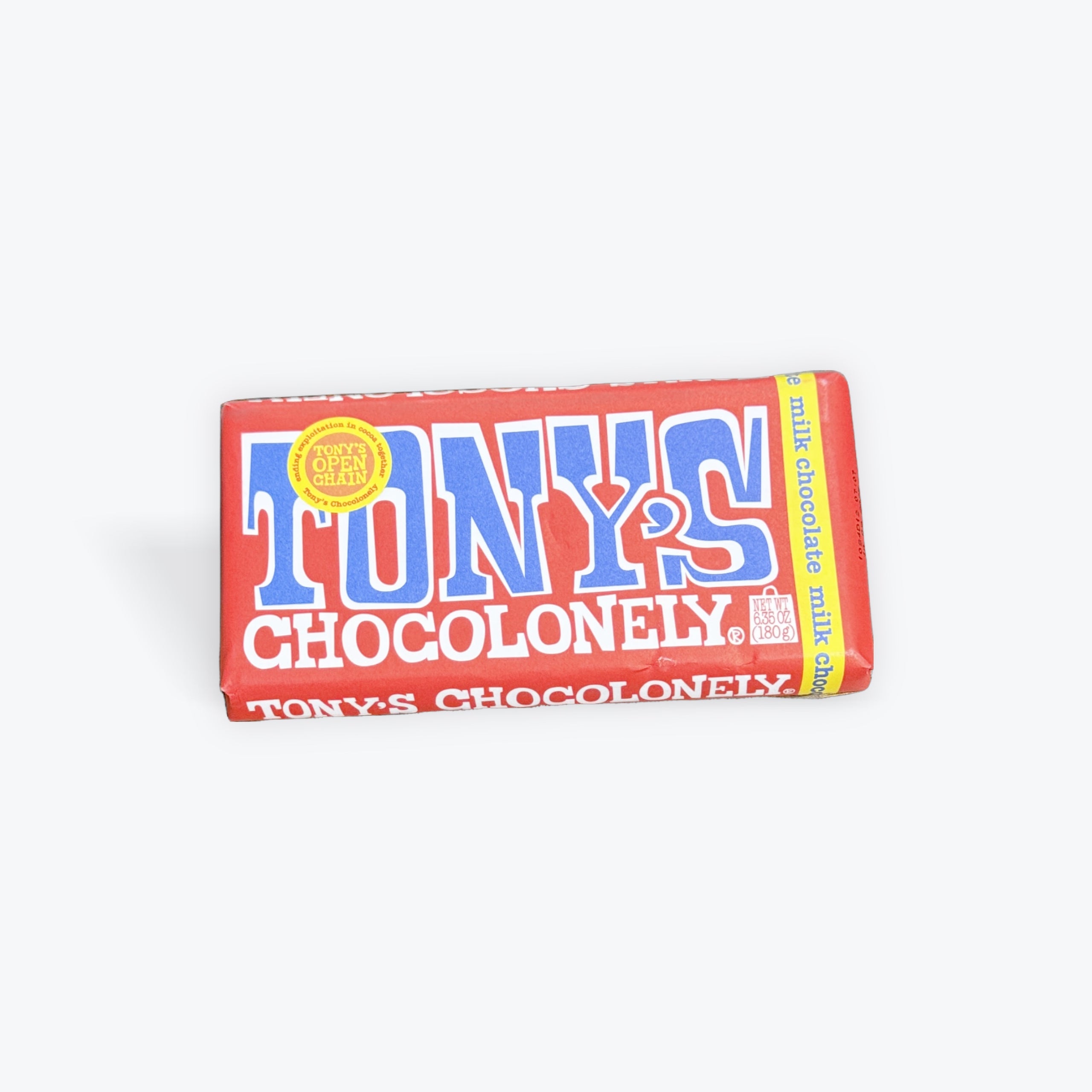
You’ve seen them. Those chunky, neon-colored bars sitting on the eye-level shelf at Whole Foods or Target, looking totally out of place next to the refined, minimalist gold foil of Lindt. Most people grab a bar of Tony's dark chocolate because the packaging looks cool or because they want a serious sugar hit. But if you actually flip the bar over, you’ll realize this isn't just another snack. It’s a loud, slightly chaotic protest against how the global cocoa industry functions.
Honestly, the first time you try to break a piece off, it’s annoying. The bars aren’t divided into nice, even squares. They are a jagged, uneven mess of triangles and rectangles. That’s intentional. It’s meant to represent the unequal distribution of profits in the chocolate supply chain. It’s a conversation starter, sure, but it’s also a bit of a pain if you’re trying to track your macros.
The Reality of Tony's Dark Chocolate and the 100% Slave-Free Mission
Most chocolate companies hide behind vague certifications. You see the little green frogs or the fair-trade stamps and assume everything is fine. Tony’s Chocolonely started because a Dutch journalist named Teun van de Keuken—that’s "Tony"—found out that the vast majority of chocolate coming out of West Africa involved illegal child labor and modern slavery. He actually tried to get himself arrested for "buying a product made by slaves" to prove a point. When the courts wouldn't prosecute him, he decided to start his own chocolate company to prove that you could make a profit while paying farmers a living wage.
Their dark chocolate isn't just about the percentage of cocoa. It’s about the "Five Sourcing Principles." They track every single bean back to the cooperative. They pay a "Tony's Premium" on top of the Fairtrade price to ensure farmers actually reach a living income.
What’s actually in the bar?
If you’re looking at the 70% Dark Chocolate (the one in the blue wrapper), it’s pretty straightforward. You’ve got cocoa mass, sugar, cocoa butter, and soy lecithin. That’s it. No vanillin or weird artificial fillers.
The texture is... different. It’s not that ultra-silky, melt-on-your-tongue sensation you get from a high-end French brand like Valrhona. It’s denser. It’s "Belgian-style," meaning it’s a bit more robust and sugary. Even the 70% feels a little sweeter than a 70% from Lindt or Ghirardelli. This is because Tony’s doesn't use a lot of extra cocoa butter, which is the expensive fat that makes chocolate feel creamy. It’s a "snacking" dark chocolate, not necessarily a "tasting" dark chocolate for connoisseurs who want to pick out notes of tobacco and dried cherry.
Is It Actually Ethical? The 2021 Controversy Explained
Wait. You might remember a few years ago when Tony’s was dropped from the "Slave Free Chocolate" list. People freaked out. It felt like a massive "gotcha" moment.
The issue wasn't that Tony’s had slaves in their own supply chain. The problem was that they used Barry Callebaut—one of the world's largest chocolate processors—to manufacture their bars. Barry Callebaut has had documented issues with child labor in their other supply chains.
Tony’s didn't hide from this. They argued that by working with a giant like Barry Callebaut, they were proving that large-scale production could be segregated and ethical. They wanted to show the big guys that it’s possible to track every bean. Some critics called it a compromise; Tony’s called it "changing the industry from within."
Whether you buy that or not is up to you, but they are incredibly transparent about it. They publish a "CLMRS" (Child Labour Monitoring and Remediation System) report every year. In their 2022-2023 report, they actually admitted to finding hundreds of cases of child labor in the cooperatives they work with.
That sounds bad, right?
But here’s the nuanced take: they found them because they were actually looking. Most companies don't find child labor because they don't have systems in place to track the individual farms. When Tony’s finds a case, they don't just cut ties and leave the family in poverty; they work to fix the underlying issue, like getting the kid into school or helping the parents increase their yield.
The Flavor Profile: What to Expect from Tony's Dark Chocolate
Let's get back to the actual eating part. If you’re a fan of Tony's dark chocolate, you probably fall into one of two camps.
- The Dark Chocolate Sea Salt Almond (Green Wrapper): This is arguably their most popular bar. The salt is chunky. The almonds are whole. It is addictive. It’s 51% cocoa, which is barely "dark" by most standards—it’s more like a dark-ish milk chocolate.
- The 70% Dark Lonesome Chocolate (Blue Wrapper): This is for the purists. It’s got a deep, roasted flavor. It’s very "cocoa-forward."
One thing you’ll notice is the "snap." A good dark chocolate should have a clean break. Because Tony’s bars are so thick—seriously, they are like bricks—the snap is more of a thud. It takes some jaw strength to get through a piece.
Nutriton vs. Reality
People often buy dark chocolate thinking it’s a "health food."
Let’s be real. A 180g bar of Tony’s is huge. It’s nearly twice the size of a standard chocolate bar. If you eat the whole thing, you’re looking at over 900 calories. Even the 70% dark has a significant amount of sugar. It’s a treat, not a supplement. However, because it’s so rich and the pieces are so chunky, you’re less likely to mindlessly inhale the whole thing in one sitting compared to a thin Hershey’s bar.
How to Properly Store and Eat Your Tony's
If you keep your chocolate in the fridge, stop. Seriously.
When you put Tony's dark chocolate in the fridge, it undergoes "sugar bloom" or "fat bloom" because of the moisture. That’s the white, powdery coating you sometimes see. It’s not mold, but it ruins the texture. Keep it in a cool, dry cupboard.
When you're ready to eat it, try this: don't chew it immediately. Let a small piece sit on your tongue. Because Tony’s is quite dense, it takes a few seconds to warm up. Once it hits body temperature, the flavors start to open up. You’ll get that earthy, slightly bitter cocoa hit, followed by the sweetness.
Where the Brand is Going Next
Tony's isn't just staying in the candy aisle. They’ve started "Tony’s Open Chain," which is basically a platform where other companies—like Ben & Jerry’s—can use Tony’s ethical sourcing model for their own products.
They are trying to turn their "Slave Free" mission into a commodity. It’s a bold business move. They want to be the "Intel Inside" of ethical cocoa. If they can get the massive conglomerates to adopt their tracking systems, the impact would be way bigger than just selling a few million bars of Tony's dark chocolate to hipsters and conscious consumers.
Practical Steps for the Conscious Consumer
If you want to support better cocoa practices but aren't sure where to start, here is how to handle your next chocolate craving:
- Read the Label Beyond the Logo: Look for "direct trade" or specific mentions of the price paid to farmers. Tony's isn't the only one doing this—brands like Taza and Theo are also great—but Tony's is the most widely available.
- Check the Percentage: If you want the antioxidant benefits of dark chocolate, stick to 70% or higher. The 51% bars are delicious, but they are mostly sugar.
- Embrace the Uneven Pieces: Use the jagged shapes as a reminder. It’s a small way to stay mindful of where your food comes from while you’re enjoying a snack.
- Buy in Bulk: Because Tony's bars are massive and have a long shelf life (especially the dark varieties), buying them when they go on sale is way more cost-effective. Dark chocolate lasts about 2 years if stored correctly.
- Use it for Baking: Because of the high cocoa butter content compared to cheap "baking chips," chopping up a bar of Tony's 70% dark for chocolate chip cookies is a total game-changer. The puddles of chocolate are much better than the waxy chips that hold their shape.
The chocolate industry is messy. It’s complicated, and it’s often exploitative. Tony’s isn't perfect, and they’ll be the first to tell you that. But they are one of the few brands actually putting their money where their mouth is and showing the rest of the industry that ethical chocolate doesn't have to be a niche, luxury product. It can be a big, bright, chunky bar that you find at the grocery store.