You’ve probably seen the posters or felt the vibration of the "Defying Gravity" bass in a theater by now. But honestly, the weirdest thing about the Wicked movie isn't the talking goats or the flying monkeys. It’s the fact that in an era where most blockbusters are basically just two actors standing in a gray warehouse surrounded by green screens, director Jon M. Chu decided to go old school. Like, really old school.
He planted a forest.
Well, a field. Actually, nine million tulips.
The wicked movie behind the scenes footage is kind of a trip because it reveals just how much of Oz was physical. It’s easy to assume everything is digital these days. You see a bright purple sky and a giant train, and your brain goes, "Oh, cool CGI." Except the train weighed 16 tons.
The 9 Million Tulip Gamble
Let’s talk about those flowers. Most productions would have used a small patch of plastic tulips and a lot of "fix it in post" energy. Not here. Production designer Nathan Crowley—the guy who helped build Gotham for Chris Nolan—convinced the team to plant nine million actual tulips in the English countryside. Specifically, they took over 20 acres of land in Norfolk.
The colors were specifically arranged to look like a rainbow.
It was a massive risk. If the weather didn't cooperate or the flowers didn't bloom in time for the shooting window, the production would have been out millions. They even had to work with local flower farmers Mark and Susanne Eves to make sure the "Munchkinland" palette was just right. When you see Glinda’s bubble descending over those fields, those aren't pixels. That’s real Norfolk mud and petals.
Building Shiz for Real
The school wasn't just a set; it was a small city. They built the Shiz University set at Sky Studios Elstree and a backlot in Ivinghoe. It included:
- A functional 100-foot-long train (the Emerald City Express).
- A real river with actual water for the student boats.
- A library with bookshelves that actually spun during the musical numbers.
It took five months just to build the university exterior. Why do this? Jon M. Chu mentioned in several interviews that he wanted the actors to feel the "gravity" of the world. When Ariana Grande is running through a hallway, she’s hitting actual wood and stone, not foam or air.
The Truth About the Live Singing
If you’ve been following the social media discourse, you know the big talking point: "They sang everything live!"
Usually, in movie musicals, actors record a "perfect" version in a studio months before filming. Then, on set, they lip-sync to that track. It’s safe. It’s clean. But Ariana Grande and Cynthia Erivo basically told the production, "No thanks."
They sang live for almost every take.
This created a logistical nightmare for the sound team. Sound mixer Simon Hayes had to figure out how to capture crystal-clear vocals while giant wind machines were blowing and 150 dancers were stomping on wooden floors. They ended up using three microphones on each lead actor—one boom and two hidden lavaliers.
Singing While Flying
Cynthia Erivo’s "Defying Gravity" was a feat of physical endurance. She was strapped into a harness, being jerked around in a corset, while having to hit those iconic high notes. There’s no floor under her. Her lungs are being squeezed by the costume.
Ariana Grande wasn't just standing around, either. At one point, she was literally singing while jumping onto a chandelier. They had to use custom-painted in-ear monitors (IEMs) that matched their skin tones perfectly so they could hear the piano accompaniment without the microphones picking up the music.
Does the final movie have some post-production "polish"? Of course. It’s a multi-million dollar film. But the "breath" and the "cracks" in the voices you hear in the theater? Those happened in the moment.
The Emerald City and That Giant Head
The Wizard’s chamber is another place where the wicked movie behind the scenes reality gets a bit surreal. Jeff Goldblum’s character has this massive mechanical bust. It looks like a high-end CGI creation.
It’s a 16-foot-tall puppet.
The head was built with hydraulics to move its facial expressions in real-time. It sat 12 feet off the ground. The crew had to move it using a complex system of controls, making it essentially a giant animatronic. It’s one of the largest physical props built for a movie in recent years.
Costumes as Architecture
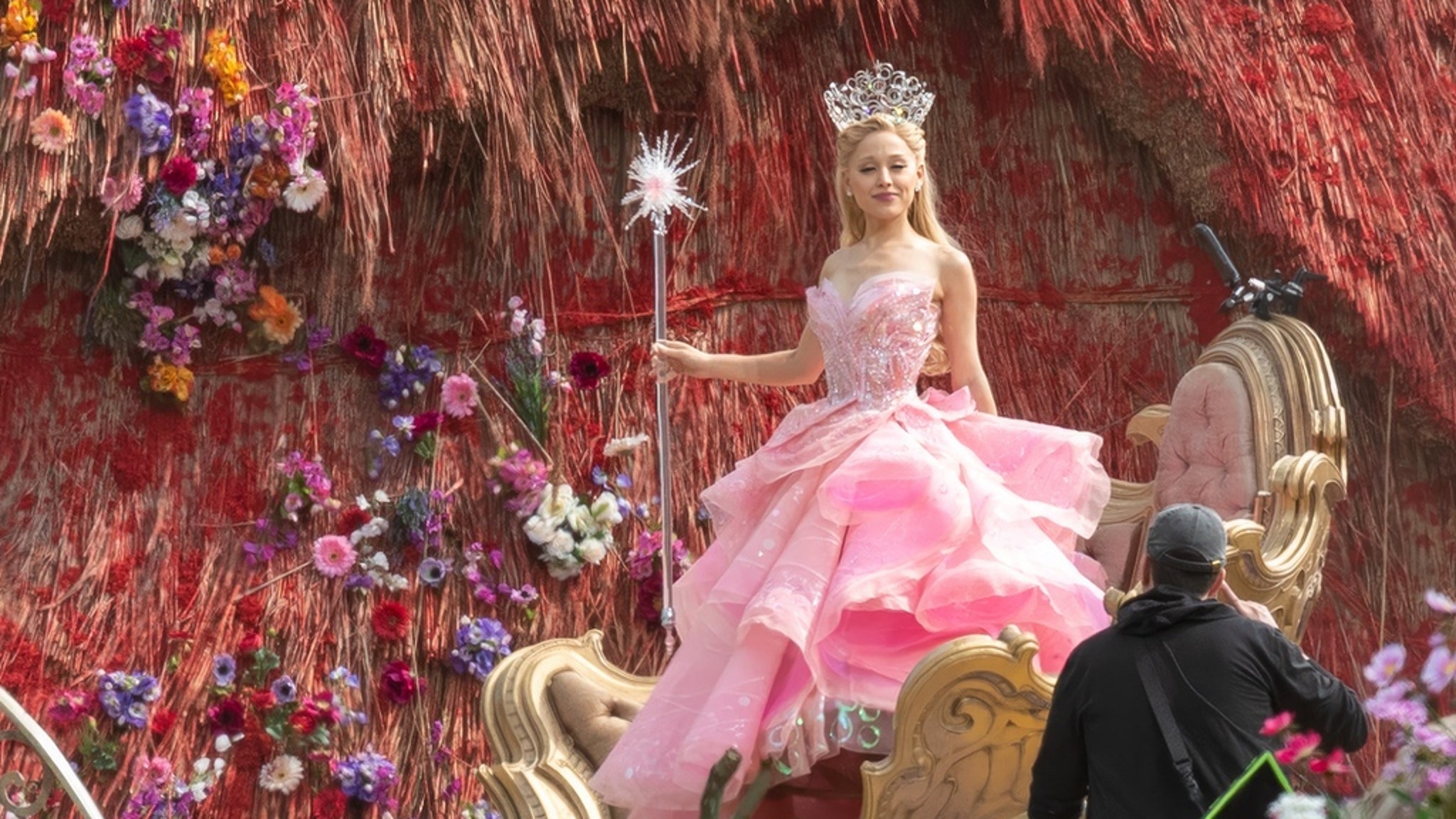
Paul Tazewell, the costume designer, didn't just make clothes; he made "wearable art." Glinda’s pink bubble dress is the standout.
It required 137 separate pattern pieces.
The bodice alone took 225 hours of hand-beading. The dress was designed using a "Fibonacci spiral" concept to give it that perfectly swirling, ethereal look. Meanwhile, Elphaba’s "Wicked Witch" outfit was inspired by textures found in nature—specifically mushrooms and coal. It’s micro-pleated fabric that looks like it’s growing out of the ground rather than being stitched in a shop.
The Green Paint Problem
Everyone asks about the green. It wasn't a digital overlay. Cynthia Erivo spent roughly four hours in the makeup chair every single morning.
They used a specific shade of MAC chroma-cake and a lot of patience. Removing it at the end of the day took about 45 minutes and a special cocktail of oils. She also wore prosthetic ears to cover her real-life piercings, because Elphaba probably wouldn't have 2020s-style ear stacks.
Why People Think It’s CGI
There’s a weird irony happening with this movie. Because the lighting is so stylized and the colors are so vibrant, some audiences are actually complaining that it looks "fake."
It’s the "uncanny valley" of practical effects.
When something is too perfect—like nine million perfectly blooming tulips—the human eye sometimes assumes it must be a computer. There’s a legitimate debate among film nerds about whether the heavy color grading and digital sky replacements "washed out" the hard work of the set builders. But if you look closely at the texture of the "Yellow Brick Road" (which was actually made of real mud and pavers), you can see the imperfections that CGI usually misses.
Actionable Insights for Fans
If you're heading back for a second viewing or waiting for the digital release, keep an eye on these specific details that prove the "realness" of the production:
- The Breath: Listen for the sharp intakes of air during "For Good." That’s the sound of live singing in a cold studio, not a sound booth.
- The Shadows: Look at how the light hits the Munchkin houses. Notice the "living roofs" made from repurposed tulip heads.
- The Train: In the Emerald City station, watch the way the 16-ton train slightly settles when it stops. Digital objects often lack that sense of weight.
- The Ears: Look for the subtle prosthetics on Elphaba. They’re designed to look like natural Ozian anatomy, hiding the actor’s actual ear shape.
The scale of this production is a bit of a dying breed. Whether you love the look or find it too "saturated," there’s no denying the sheer human effort involved in planting a forest just to sing a song inside it.
To really appreciate the craft, look for the official "The Making of Wicked" featurettes on YouTube. Specifically, find the Architectural Digest tour with Nathan Crowley; it shows the Shiz library in a way that makes you realize just how much engineering went into a single five-minute musical number.