You’ve probably seen the gates. If you’ve ever wandered through the northern reaches of Regent’s Park, dodging joggers and stray footballs, you’ve likely noticed that massive stretch of black iron fencing. Behind it sits a house that looks like it belongs in a period drama, yet it’s technically American soil—or at least, as close as you can get to it without a boarding pass. This is Winfield House, the US ambassador's residence London, and honestly, it’s a lot weirder and more interesting than the "official government building" label suggests.
Most people assume it’s just a fancy office. It isn't. It is a twelve-and-a-half-acre private estate in the middle of a crowded capital. That’s insane. To put that in perspective, it has the second-largest private garden in London, losing out only to Buckingham Palace. While the King has his sprawling lawn, the US Ambassador is basically living in a close second.
The Woolworth Fortune and a Very Expensive "I Told You So"
The story of the US ambassador's residence London doesn't start with diplomacy. It starts with revenge. Or maybe just a really big checkbook.
Barbara Hutton, the heiress to the Woolworth five-and-dime fortune, built this place in the 1930s. She was often called the "Poor Little Rich Girl" by the tabloids because, despite having all the money in the world, her personal life was kind of a train wreck. She bought the lease for the land because she wanted a safe, private place for her son after a messy kidnapping threat.
The previous house on the site, St. Dunstan’s, had burned down. Hutton didn't want a renovation; she wanted a statement. She hired the architects Wimperis, Simpson and Guthrie to build a Neo-Georgian masterpiece. The result was Winfield House, named after her grandfather, Frank Winfield Woolworth.
She spent a fortune. We’re talking about French parquetry floors, hand-painted Chinese wallpaper from the 18th century, and marble bathrooms that would make a modern billionaire blush. But she didn't stay long. WWII happened. The house was turned over to the Royal Air Force, and by the time the smoke cleared, Hutton realized that maintaining a palace in a post-war economy was a headache she didn't need.
In 1946, she sold it to the United States government for a whopping one dollar.
Well, it was more of a "gift" with a nominal fee, but the gesture was massive. She wanted it to be the official home for the ambassador, and ever since, it has been the epicenter of US-UK relations. It’s where the "Special Relationship" gets fed, watered, and occasionally argued about over very expensive dinner plates.
Why the Garden is Actually a Big Deal
You can’t talk about the US ambassador's residence London without talking about the grass.
It sounds boring, right? A lawn is a lawn. But this is the "Great Lawn." It’s a massive, flat expanse of green that serves as a literal landing pad for history. When a US President visits London, they don’t usually fight traffic in the "Beast" (the presidential limo) all the way from Stansted or Heathrow. They fly.
Marine One—the green and white helicopter—lands right there on the grass.
There’s a funny bit of lore among embassy staff about the lawn. Apparently, the secret service and the flight crews have to be incredibly precise because the weight of a heavy military helicopter can actually mess up the drainage systems under the turf. It’s a constant battle between the needs of the State Department and the needs of the head gardener.
Speaking of the garden, it’s not all just flat grass. There are wooded areas, secret paths, and a rose garden that would hold its own at Chelsea. Because it’s surrounded by Regent’s Park, but separated by a high security fence, the wildlife is pretty diverse. You’ve got foxes, owls, and squirrels who have no idea they are technically trespassing on diplomatic property.
Inside the Rooms Where It Happens
Inside, the house is a mix of high-end museum and a very, very formal family home.
The ground floor is basically a series of "State Rooms." This is where the heavy lifting of diplomacy happens. You’ve got the Garden Room, the Family Dining Room (which is still huge), and the Formal Dining Room.
The decor is a bit of a trip.
- The Wallpaper: Some of the rooms still feature that 18th-century Chinese wallpaper Barbara Hutton installed. It’s delicate, hand-painted, and worth more than most people’s entire houses.
- The Art: Through the "Art in Embassies" program, the residence is constantly rotating high-end American art. You might see a Sargent hanging next to a contemporary abstract piece.
- The Furniture: It’s mostly English and French antiques, giving the whole place a very "Old World" vibe that balances the American flags at the entrance.
But here’s the thing: people actually live here. The Ambassador and their family occupy the top floor. It’s their house. They have to deal with the same stuff we do—creaky floorboards, drafty windows (it is a massive old building, after all), and figuring out where to put their own personal photos among all the gold-leaf mirrors.
Imagine trying to relax in your pajamas while a Secret Service detail is standing outside your bedroom door and a foreign minister is having a cocktail downstairs. It’s a weird life.
The Security Reality
Let’s be real: you aren't just walking into Winfield House.
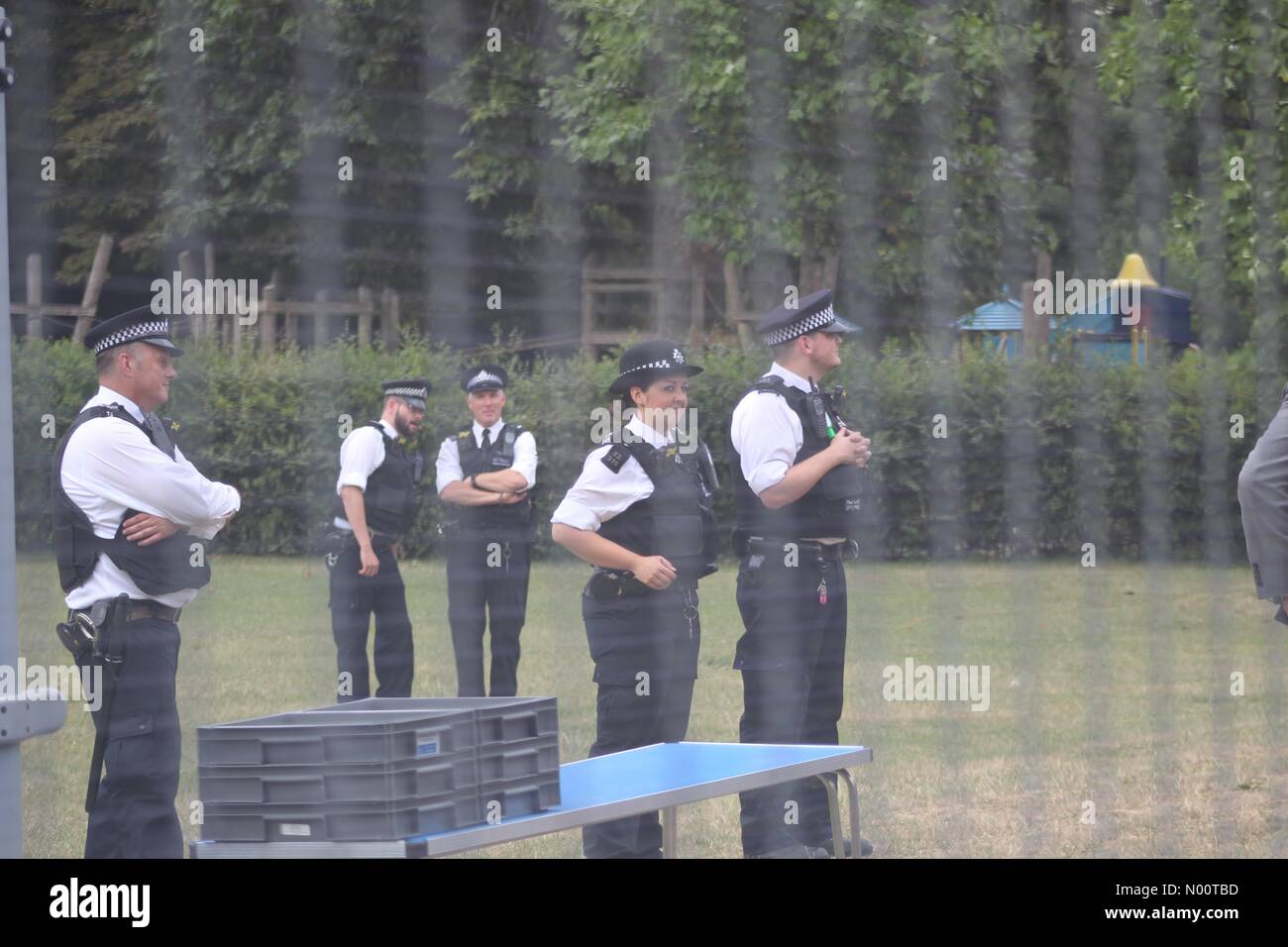
The security is intense. It’s not just the guys with earpieces. The US ambassador's residence London is one of the most protected private sites in the UK. After 9/11, and throughout various global tensions, the perimeter has been beefed up significantly.
The fence is reinforced. There are sensors everywhere. The gatehouse looks like a mini-fortress. If you’re invited for a party—and the Fourth of July parties there are legendary—you go through more screening than you do at Gatwick.
But even with the high security, the US government tries to keep it from looking like a bunker. They want it to look like a stately home because diplomacy is about "soft power." It’s hard to project friendship and openness if you’re living behind ten feet of concrete and barbed wire. The balance they strike is keeping the aesthetic of a London manor while having the tech of a high-security facility.
A History of Famous Guests
If those walls could talk, they’d probably be told to sign an NDA.
Every US President since Truman has had some connection to the place, even if they didn't all sleep there. Queen Elizabeth II was a frequent guest. In fact, she famously visited for dinner with the Obamas in 2011. There’s a great photo of them in the Garden Room, looking totally at ease.
It’s not just politicians, though. The residence hosts CEOs, activists, artists, and celebrities. It’s used as a venue to celebrate American culture and to build bridges with British society. Whether it’s a Thanksgiving dinner for Fulbright scholars or a high-level briefing on trade, the house is always working.
One of the more interesting residents was Ambassador Anne Armstrong (the first woman to hold the post) in the 1970s. She famously brought a bit of Texas flair to the place. Every ambassador leaves a mark. Some focus on the gardens; others focus on the interior design. Some use the house as a loud, proud megaphone for American interests, while others use it for quiet, behind-the-scenes "cocktail diplomacy."
The "Special Relationship" in Brick and Mortar
Why does the US ambassador's residence London even matter in 2026? We have Zoom. We have secure satellite uplinks. Why keep a massive, expensive house in the middle of London?
Because you can’t replace the "side chat."
In diplomacy, the most important conversations often happen in the hallway after a meeting or over a coffee in a garden. Winfield House provides a "neutral-but-American" ground. It’s a place where a British Prime Minister can talk to an American official away from the cameras of Downing Street.
It represents a permanent commitment. By maintaining such a significant estate, the US is saying, "We aren't going anywhere." It’s a physical manifestation of the alliance.
What You Should Know Before You Go (Looking)
If you’re planning to head to Regent’s Park to catch a glimpse, keep a few things in mind.
First, you can’t see much from the street. The trees are thick, and the house is set far back. Your best bet for a view is actually from the higher ground in Regent’s Park or, if you’re lucky, from the top of a double-decker bus passing by at the right angle.
Second, don’t linger too long at the gates with a camera. The police and security are generally polite, but they are very, very observant. They’ve seen every "I’m just a tourist" move in the book.
Third, respect the fact that it is a residence. While it’s a tool of the state, it’s also someone’s bedroom, kitchen, and living room.
Actionable Takeaways for the Curious
If you’re fascinated by the intersection of architecture and diplomacy, here is how you can actually engage with this world without needing a diplomatic passport:
- Check the Embassy’s Social Media: The US Embassy in London is surprisingly active on Instagram and X (Twitter). They often post "behind the scenes" photos of events at Winfield House. It’s the only way most of us will ever see the inside of the dining room.
- Visit the Open House London Weekend: Occasionally—though not every year—Winfield House or the Embassy itself participates in London’s "Open House" event. This is your gold-ticket chance to get inside. Keep an eye on the official Open City website for listings.
- Read the Memoirs: If you want the real dirt, read memoirs by former ambassadors like Louis Susman or Matthew Barzun. They often talk about the quirks of living in Winfield House, from the ghost stories to the difficulty of getting a good burger in a house run by a professional kitchen staff.
- Explore Regent's Park: Even if you can't get in, walking the perimeter of the estate gives you a sense of its scale. It’s one of the few places in London where you can feel the sheer weight of history and power just by standing near a fence.
The US ambassador's residence London remains one of the most guarded secrets in the city—not because people don't know it exists, but because so few actually understand what goes on behind those black gates. It’s a piece of America in the heart of Britain, a gift from a grocery store heiress that became a pillar of global politics.